
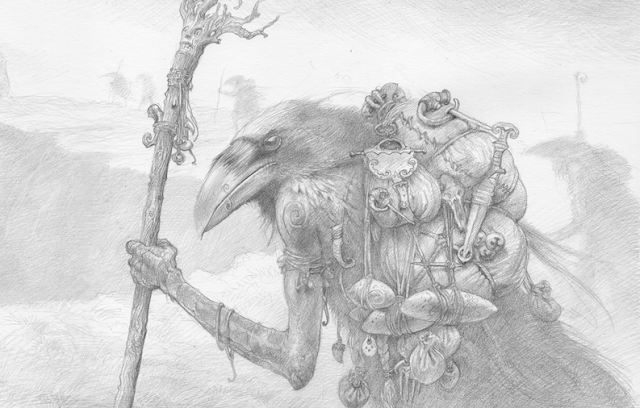
John Howe Worked on Mortal Engines Concept Design in Wellington
Peter Jackson and Christian Rivers kept Mortal Engines close to the wider Wellington design family. One of the most interesting names connected to the film was John Howe, the famed fantasy illustrator best known for his major influence on the visual world of The Lord of the Rings.
Howe revealed that he spent nine weeks in Wellington, New Zealand, creating preparatory drawings for Mortal Engines. That is a small but important detail in the film’s design history. It shows the production reaching beyond machinery specialists and into the kind of mythic visual thinking that helped give Middle-earth its cinematic weight.
The easy comparison is this: John Howe is to The Lord of the Rings what Ralph McQuarrie is to Star Wars. Not the only artist involved, of course, but one of the defining visual interpreters of a major fantasy world.
Howe on Mortal Engines and Steampunk
While promoting his Paris showcase at Galerie Arludik, Howe discussed his work on Mortal Engines in an interview with Premiere. The translated version of the quote is rough, but the important parts are clear.
Howe said he had spent nine weeks in New Zealand working on preparatory drawings for Mortal Engines, describing the world of the novels as extraordinary, astonishing, and steampunk. He also joked that the project took him outside his usual battlements.
That last point is useful. Howe is strongly associated with castles, armour, mythic landscapes, medieval ruins, dragons, ravens, forests, and Tolkien’s deep visual tradition. Mortal Engines asks for something related but different: cities on tracks, scavenged technology, industrial scale, airborne settlements, and the broken future of the old world.
It makes sense that Howe would describe the project as taking him away from his usual battlements. Mortal Engines still needs grandeur, but it is not clean heroic grandeur. It needs rust, civic madness, wreckage, weird engineering, and landscapes shaped by the aftermath of the Sixty Minute War.
Design note: “steampunk” is a useful shorthand for Mortal Engines, but it does not cover the whole texture. Reeve’s world is post-apocalyptic, pseudo-Victorian, industrial, archaeological, and often comic. The machinery should feel old, repaired, repurposed, and culturally misunderstood.
How Howe Worked With Christian Rivers
The interview also gives a useful glimpse into the production structure.
Howe said he barely saw Peter Jackson during the process and worked mostly with director Christian Rivers. That matters because it suggests Jackson was not simply shadow-directing every visual decision. Rivers was being given space to lead the film’s design and direction.
That is consistent with the wider production model. Jackson was a major creative force as producer and co-writer, but Mortal Engines was Rivers’ feature directing debut. Rivers came out of the Jackson-Wētā pipeline as a storyboard artist, visual effects artist, and long-time collaborator, so the project sits somewhere between apprenticeship, trust, and inherited production culture.
The comparison with District 9 is fair enough. Jackson produced that film while Neill Blomkamp developed and realised his own grimy science-fiction vision. Mortal Engines has a similar Wellington production-family feeling, even though the result is much bigger, stranger, and more mechanically overloaded.
What Kind of Work Was Howe Doing?
Howe did not reveal exactly what he designed. He described his role as limited and said he was exploring an environment over nine weeks.
That sounds like concept sets, mood pieces, landscapes, structures, or world spaces rather than character costumes or finished city engineering. In Mortal Engines terms, that could mean anything from city environments and old-world ruins to static settlements, interiors, mountain landscapes, or the broader shape of the post-apocalyptic world.
The useful point is not to overclaim. Nick Keller, Wētā Workshop, and the wider design team did much of the major conceptual heavy lifting for the film. Howe’s role appears more focused, but still valuable. For a world like Mortal Engines, even a short burst of environmental design from Howe matters because atmosphere is half the battle.
New Zealand’s own Nick Keller did a lot of the major conceptual work for Mortal Engines, especially around the film’s city, airship, and environment design language.
Why John Howe Fits Mortal Engines
Howe’s strength is not just drawing beautiful fantasy images. It is giving invented worlds a sense of age.
That is exactly what Mortal Engines needs. The cities and settlements cannot look freshly designed. They need layers. Repairs. Myth. Function. Bad decisions made by previous generations. A viewer should feel that every machine has a history, every ruin has been misunderstood, and every society has built its identity from broken remains.
Howe’s background in Tolkien design makes him useful there. Middle-earth depends on deep history. Mortal Engines depends on broken history. The worlds are very different, but the artistic problem has a family resemblance: make the impossible feel inherited.
That is why the Howe connection is worth noting. Even if his role was brief, it places Mortal Engines inside a larger Wellington tradition of concept art as worldbuilding, not just decoration.
John Howe’s Paris Showcase
The Mortal Engines comments surfaced while Howe was promoting his Paris art showcase at Galerie Arludik. The exhibition material is a good reminder that Howe’s reputation extends well beyond one franchise. His work carries that old-school illustrator quality: careful drawing, mythic atmosphere, strong silhouettes, and a deep affection for ruins, birds, armour, and strange thresholds.

For more on Howe’s wider art practice, Myth and Magic: The Art of John Howe is a useful companion book. It helps explain why Jackson valued Howe’s eye during The Lord of the Rings, and why that same visual intelligence could still be useful on a world as strange as Mortal Engines.
