
The meaning of A Darkling Plain comes from Matthew Arnold’s poem Dover Beach
I’ll admit that when I first learned the title A Darkling Plain, I had no idea what it meant.
It sounded ancient. Grim. A bit haunted. Possibly something from The Dark Crystal, or the name of some unpleasant spirit that lives under a ruined staircase and steals your biscuits.
But of course, Philip Reeve was reaching for something sharper than that. The title is not just spooky window dressing. It is a literary key to the whole final movement of the Mortal Engines Quartet.
Just as Reeve drew the phrase “mortal engines” from Shakespeare’s Othello, the title A Darkling Plain comes from Matthew Arnold’s famous 1867 poem Dover Beach.
The line from Dover Beach
Here is the passage Reeve is drawing from:
Ah, love, let us be true
To one another! for the world, which seems
To lie before us like a land of dreams,
So various, so beautiful, so new,
Hath really neither joy, nor love, nor light,
Nor certitude, nor peace, nor help for pain;
And we are here as on a darkling plain
Swept with confused alarms of struggle and flight,
Where ignorant armies clash by night.
The phrase “darkling plain” simply means a plain growing dark, or a landscape swallowed by darkness. But in the poem it means more than scenery. Arnold is describing a world that looks beautiful and full of promise, but underneath has lost certainty, peace, faith, and moral direction.
That fits A Darkling Plain almost too well.
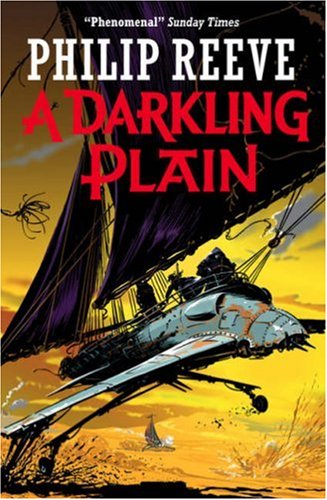
“Ignorant armies” and the war at the end of the world
The final image in Arnold’s poem, “ignorant armies clash by night,” is often connected with ancient warfare, especially the confused night fighting described by Thucydides during the Peloponnesian War. The important idea is not a clean heroic battle. It is chaos. Soldiers cannot properly see who they are fighting. Fear spreads faster than reason. Armies collide in the dark, driven by panic, pride, and half-understood commands.
That is very close to the world of A Darkling Plain. By the fourth book, the conflict between the Traction Cities and the Anti-Traction League has become bigger than any single character can control. London is gone, but the ideology of Municipal Darwinism still lurches on. The Green Storm, born as a force against predatory cities, has hardened into its own machine of violence. Both sides believe they are necessary. Both sides are convinced history belongs to them. Both sides are wrong in ways that cost ordinary people their lives.
The Great Hunting Ground itself becomes Reeve’s darkling plain. It is not just a location. It is the moral landscape of the series. A scraped, damaged, post-apocalyptic world still haunted by the Sixty Minute War, still shaped by the broken technologies of the Ancients, still paying for old mistakes with new bodies.
Why the title fits the whole Mortal Engines Quartet
The genius of the title is that it does not only describe the final book. It describes the accumulated condition of the whole series.
Mortal Engines begins with the thrilling absurdity of mobile cities eating smaller towns. It has adventure, airships, spies, ruined technology, and enormous metal jaws rolling across Europe. But beneath the spectacle is a ruined moral order. The world has built an entire philosophy to excuse hunger. Municipal Darwinism turns predation into civic pride. The bigger city eats the smaller one, and everyone pretends this is natural.
By Predator’s Gold, Infernal Devices, and finally A Darkling Plain, Reeve keeps stripping away that romantic surface. The cities are not just magnificent machines. They are desperate systems. The Anti-Tractionists are not simply noble rebels. The Stalkers are not just monsters. Even characters such as Anna Fang, who begin as legends, are pulled into the machinery of war, memory, resurrection, and ideology.
That is where the title bites hardest. Everyone in A Darkling Plain is moving through darkness. Tom and Hester are trying to survive the consequences of the lives they have built. Wren and Theo inherit a conflict they did not create. The Green Storm and the Tractionists keep fighting for versions of the future that may already be dead. Even the old weapons of the Ancients, especially the orbital horror of ODIN, remind us that this world has already destroyed itself once and still has not learned enough to stop doing it again.
Nimrod Pennyroyal and Ignorant Armies
Reeve even nods directly to Arnold’s poem inside the novel. Near the end of A Darkling Plain, the magnificently useless Nimrod Pennyroyal writes a book called Ignorant Armies.
That joke is doing more work than it first appears. Pennyroyal is one of Reeve’s great comic frauds, a cowardly opportunist who survives by turning other people’s pain into stories that flatter himself. So when he uses Arnold’s phrase, he is not suddenly becoming wise. He is doing what Pennyroyal always does. He is packaging catastrophe as literature, selling the end of the world as memoir.
But the title still fits. The armies really were ignorant. Not stupid, exactly. Ignorant in the deeper tragic sense. Ignorant of what they were preserving. Ignorant of what they were destroying. Ignorant of how much of their war had already been scripted by fear, old machines, old lies, and old appetites.
The darkling plain is also emotional
There is another reason the title works so well. A Darkling Plain is not only about war. It is about people trying to love each other in a world that has made love difficult.
That is right there in Arnold’s poem too: “Ah, love, let us be true to one another.” The speaker looks at a world without certainty or peace and turns back to the one human bond that might still matter. Reeve’s novel does something similar. Its grand machinery matters, but its real force comes from Tom, Hester, Wren, Theo, Shrike, Anna Fang, and all the damaged loyalties that survive inside the wreckage.
Hester Shaw, in particular, makes the title feel personal. She has always lived on a kind of darkling plain. Scarred, hunted, angry, loved badly, loving badly, and never quite able to believe she belongs in any peaceful future. Her story gives the series its emotional wound. Tom gives it its moral ache. Wren gives it inheritance. Shrike gives it memory. The war gives it scale.
That is why the ending lands with such weight. A Darkling Plain is not simply the book where the big war happens. It is the book where Reeve asks what comes after centuries of motion, hunger, revenge, and myth. Can the world stop moving long enough to heal? Can people step away from the machines that shaped them? Can anything grow on a plain that has been dark for so long?
A perfect title for the final book
So yes, A Darkling Plain comes from Dover Beach. But it is not just a fancy literary borrowing. It is one of those titles that becomes clearer the more of the story you understand.
It captures the Great Hunting Ground. It captures the Tractionist and Anti-Tractionist war. It captures the old technologies of the Ancients still poisoning the future. It captures the confusion of armies and the loneliness of people trying to stay human inside history’s machinery.
Most of all, it captures the mood of the final Mortal Engines novel: beautiful, bleak, strange, wounded, and still searching for a little light.
If you are working through the series, see our guide to the best order to read the Mortal Engines books. And if you want the full verdict on the quartet’s final chapter, here is our review of A Darkling Plain.
