
SPOILERY REVIEW.
A Darkling Plain is Philip Reeve’s triumphant end to the Mortal Engines realm
You would think a guy running a Mortal Engines movie website would have read all the books before he began down such a path, but no. We were playing catch up.
After the great story that was Infernal Devices, I began to wonder how the damn tale was going to end.
How was everything going to come together? How was Reeve going to tie off Tom, Hester, Wren, Theo, Stalker Fang, ODIN, the Green Storm, the Traction Cities, the old sins of the Sixty Minute War, and all that glorious Municipal Darwinist madness?
I had high hopes. It felt well set up for a final climactic finish.
And then I accidentally read something online about the ending.
I was a bit sad about that because, as it turns out, this is one of the great book endings. The sort of ending you want to hit you clean, not arrive half-spoiled because you wandered into the wrong corner of the internet.
But it is all about the journey to the end, right?
And what a journey.
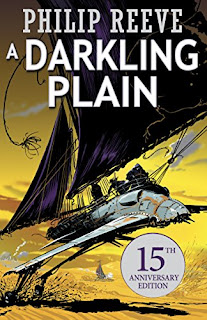
This was the first Mortal Engines book to really push the story to blockbuster, global levels. In doing so, it loses a fair bit of the teenage angst, yes, it is still there, but it moves into the real deal of the piece:
Killing things.
You thought there was a lot of death in the prior books?
By Quirke, does Philip Reeve have some news for you.
Wait.
What I think I am trying to convey is that the weight of the whole world Reeve has created rests on the shoulders of this book. And it is carried extremely well by Tom, Wren, Theo, Shrike, Anna Fang, and even bad old Pennyroyal.
Hester returns like the original Terminator, only meaner
My first favourite moment comes early.
The book begins with the tale of Theo, who proved his worth in Infernal Devices. It is good stuff, but it also works as a great distraction for the arrival of a key character.
A dark shadow comes out of the desert on some kind of sand boat with sails. It feels like a threat. It feels like something old, damaged, and dangerous has crossed the wastes looking for trouble.
As a reader, I felt the dread straight away.
And then it turned out to be Hester.
Yep. She is back. Like the original Terminator, but meaner.
Get out of the way, Sarah Connor.

More spoilers and things
Got that?
Good.
My second favourite moment was when Anna Fang went off the reservation, as if she was not already halfway there, and turned the ODIN weapon on the good people of Earth.
It is gripping writing by Philip Reeve, page after page of tension, dread, and horrible momentum. This moment is an excellent pay-off for all the groundwork that went into setting up Stalker Fang and everyone chasing the MacGuffin of the Tin Book.
Reeve’s line, “There was nothing there but fire, the million mournful voices of the wind,” is a chilling reflection of the destruction Fang has just caused.
It also reminded me, oddly, of Arthur C. Clarke’s wonderful short story, The Nine Billion Names of God. Not because the stories are the same. They are not. But because both brush against that terrible imaginative space where the end of the world is not just a concept.
That is how far Reeve has come by the fourth book. You can call parts of the series “same same but different” if you want, but A Darkling Plain feels more deliberate than that. It has the sense of an author steering hard toward an ending he knows will matter.
I suspect Reeve had thought of that amazing ending and could not wait to get there himself. But he knew he had to set the pieces just right first, otherwise it would not land with the weight it needed.
Hester’s choice
Total spoiler question.
Ready player one?
Hester’s suicide.
Did she really hate herself that much?
Tom and Hester were star-crossed lovers in many ways, but she was no Juliet. She was never built for soft tragedy. She was built out of rage, damage, survival, obsession, and a kind of love that cut everyone who came close to it.
Why could she not live on for Wren? We know she resented her a bit from the events of Infernal Devices, but jeez Louise.
Game over, man. Game over.
And yet, as brutal as it is, the choice feels true to Hester. That is what makes it hurt. Reeve does not suddenly soften her into someone else. He lets her remain Hester right to the end: frightening, wounded, selfish, devoted, impossible, and unforgettable.
Pennyroyal, somehow, gets his moment
Professor Nimrod Pennyroyal was a cliched pastiche of a fellow from the moment he met Tom and Hester in Predator’s Gold.
In the end, he plays a heroic part, which is clever because everything seems nicely set up for a Shrike and Fang rematch. Pennyroyal’s intervention at the right moment is an enjoyable surprise.
I mean that in terms of reading the book, not necessarily for the character. No, he was a pain in everyone’s ass and probably deserved to get a knife in the eye from Hester.
But he did not.
I suspect Reeve is too nice a guy to let that happen.
A fine end to the series
The book has the usual trials and tribulations that we have come to expect from the Mortal Engines Quartet. The twists and turns are well signalled, and it is great to see choices made in Infernal Devices play out so strongly here.
If you are a Mortal Engines fan, you have probably already read this book, so I am sure you will agree that it is a fine end to the series.
I really, really hope Reeve never even thinks of drafting a sequel to the Quartet itself. There are not many book endings that I will remember like the ending of this novel.
Yes, I have mentioned the last paragraph three times now.
It is that good.
A literary twist up there with the Fight Clubs and Life of Pis of this world.
If you have read the first three books in the series, this is the novel that finishes what was started in Infernal Devices, and we recommend you grab A Darkling Plain from Amazon today.
Otherwise, you really should start with the first novel, Mortal Engines. You may fall in love with it from the first line.
