
Thunder City begins with a problem Philip Reeve created for himself. He already finished Mortal Engines.
A Darkling Plain did not leave the original quartet begging for another lap around the scrapyard. It gave Tom, Hester, Wren, Anna Fang, Shrike and the whole broken Traction Era a brutal, beautiful ending. So when Reeve returns to this world with Thunder City, set just over a century before the original book and built around an entirely new cast, the question is not “is it nice to be back?”
Of course it is nice to be back. There are moving cities, undead war machines, civic stupidity and terrible people making terrible decisions in hats.
The real question is whether Thunder City earns the return.
Mostly, it does.
This is not Reeve trying to revive Tom and Hester. It is not a sequel trying to unpick A Darkling Plain. It is a new adventure from an earlier phase of the Traction Era, when Municipal Darwinism is already mad, but has not yet become the fully ravenous system we meet in the original books. The cities are still hungry. The people are still pretending the hunger has rules. That is where Reeve has found his way back in.
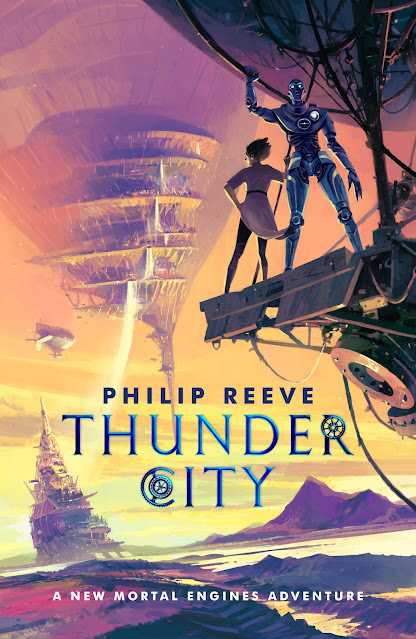
Quick verdict: Thunder City is a confident return to Philip Reeve’s Traction Era. It cannot match the emotional wreckage of the original Mortal Engines Quartet, but it does not need to. It gives us Tamzin Pook, a new crew, Revenants, civic lunacy and enough rusted invention to prove this world still has room to move.
What is Thunder City about?
Thunder City introduces Tamzin Pook, a fighter in the Amusement Arcade. Her job is simple enough, if your idea of simple involves stepping into an arena and killing Revenants, dead brains housed in armoured engine bodies.
So that is a cheery way to grow up.
Tamzin knows survival. That is her world. Not family. Not safety. Not long-term emotional planning. Just the next fight, the next threat, the next mechanical corpse trying to end her day. Then Miss Torpenhow arrives and drags her into a larger problem involving the wheeled city of Motoropolis, which has been taken over by rebels after its leaders were killed.
Motoropolis needs saving. Unfortunately, the person who may have a claim to saving it is Max Angmering, a mayor-to-be who is not exactly screaming heroic destiny from the rooftops. Add in Hilly Torpenhow, washed-up mercenary Oddington Doom, assassins, city politics and Reeve’s usual appetite for putting strange people under terrible pressure, and Thunder City becomes a rescue mission, a road story, a found-family caper and a political restoration job with undead murder machines attached.
Which is to say, it is very much a Mortal Engines adventure.
Tamzin Pook, arena fighter and reluctant hero
Tamzin is the test of the whole thing.
A new Mortal Engines book cannot survive on machinery alone. The cities are wonderful, yes. The names are funny. The old-tech weirdness is delicious. But the original quartet did not last because London had tracks. It lasted because Tom was naive, Hester was terrifying, Shrike was heartbreaking and Anna Fang had the sort of mythic cool that made every page around her feel more charged.
Tamzin is not instantly iconic in that way, but that is not the brief. She works because Reeve builds her out of survival first and heroism second. She is not a wide-eyed museum boy like Tom. She is not the scarred blade of Hester Shaw. She is not Wren, carrying the resentments and curiosity of the next generation. Tamzin begins as someone shaped by spectacle and violence. Her body is useful. Her courage is practical. Her trust is limited for good reason.
That makes her a strong lead for this earlier Traction Era. She belongs to a world that turns suffering into entertainment and danger into a business model. The Amusement Arcade is a nasty little idea because it feels both absurd and completely believable. Of course people in this world would watch a child fight undead machines. Of course somebody would sell tickets.
Reeve does not overplay Tamzin’s damage. That helps. She is not written as a walking wound. She is capable, guarded and often funny by accident. Her growth comes from being forced into a crew, then slowly discovering that survival by itself is not much of a life.
Miss Torpenhow and the new crew
Thunder City has to do something that Bridge of Storms later benefits from: it has to build the crew.
That takes time. Not too much time, but enough that the early chapters carry the slight weight of setup. Reeve has to introduce Tamzin, explain the Arcade, establish the political mess around Motoropolis, bring Miss Torpenhow into the story, locate Max Angmering, and make Oddington Doom feel like more than a name found at the bottom of a drawer marked “Philip Reeve characters, very good ones.”
The good news is that the crew comes together well. Miss Torpenhow is not simply the respectable adult dragging the wild child into a mission. She has purpose, will and just enough exasperation to make her fit the world. Hilly gives the story another emotional angle. Max is useful because he is not the obvious hero the plot appears to need. Oddington Doom brings the battered mercenary flavour, the sort of man who sounds as though he has already survived three better adventures and two worse marriages.
Together, they give Thunder City its shape. It is not just Tamzin versus the world. It is Tamzin learning that a group can be a burden, a risk, a nuisance and, inconveniently, the thing that saves you.
Revenants, Stalkers and Reeve’s undead machinery
The Revenants are one of Thunder City’s best hooks because they give the book a clear connection to one of the great Mortal Engines obsessions: what happens when a person becomes a weapon and the machinery refuses to let them rest?
The original books gave us Stalkers, and with Shrike, Reeve found one of the strangest emotional centres in the whole saga. Shrike was frightening because he was a killer. He was unforgettable because he was not only a killer. He carried grief, memory, loyalty and a broken echo of love inside the metal.
Thunder City does not simply remake Shrike. Smart move. You do not improve on that character by photocopying him and adding more rivets. The Revenants begin as spectacle and threat, which fits Tamzin’s arena life perfectly. They are bodies turned into entertainment. Dead brains in armoured engines. The old horror of the Traction Era, repackaged for applause.
That is grim, and it should be. Reeve has always understood that the nastiest ideas in this universe are not hidden in secret labs. They are often public, civic, ticketed and well-lit.
The return of civic lunacy
Reeve’s cities are never just machines. That is why the setting still works.
A lesser version of Mortal Engines would be satisfied with “big city has wheels.” Reeve knows the wheels are only the start. What matters is the society built on top of them: the slogans, the markets, the cowardice, the vanity, the politics, the absurd civic pride and the terrible belief that if a system has been running for long enough, it must be sensible.
Thunder City has that flavour. The Amusement Arcade is not just a colourful location. It tells you what this era finds entertaining. Motoropolis is not just a threatened city. It is a political problem with engines attached. The whole book works best when it shows this earlier world pretending it still has order, while the logic of traction cities keeps dragging everyone toward appetite and collapse.
That is the sly thing about setting this book before Mortal Engines. The world is not as far gone as it will be later, but it is already sick. The manners are better. The disease is the same.
The pace: slower to ignite, strong once moving
Thunder City is not as immediately streamlined as Bridge of Storms, and that is understandable. This is the setup book. It has to build the engine while driving.
The opening has plenty going for it. Tamzin in the Arcade is a strong image. The Revenants give the book teeth. Miss Torpenhow’s mission gives the story a destination. Still, the book takes a little while to click into its best rhythm because it is doing a lot of foundation work.
Once the crew has formed and the larger political problem sharpens, Thunder City becomes more confident. Reeve is very good at movement once his pieces are on the board. He writes action cleanly. He does not stop every three pages to explain the bolts. He gives just enough detail to make a place feel strange, then gets on with the trouble.
That directness matters. Reeve’s prose is one reason these books remain so readable. He can make a strange world feel full without making the reader carry a sack of lore up a hill.
What Thunder City is really about
Under the adventure, Thunder City is about survival as performance.
Tamzin has learned to live by turning danger into a show. The Arcade has learned to profit from that show. The crowd gets excitement. The system gets money. The fighter gets another day alive, if she is lucky. That is not just backstory. It is a nasty little model of the whole Traction Era.
Cities eat cities and call it economics. Arenas feed children to Revenants and call it entertainment. Rebels seize a city and call it justice, or necessity, or whatever word makes the violence sound cleaner. Reeve’s world is full of people renaming appetite until it sounds respectable.
That is where Thunder City has more bite than its adventure shape first suggests. It asks whether a city can be saved without preserving the systems that made it corrupt in the first place. It asks whether survival is enough. It asks whether a person built for fighting can become something other than a weapon.
Those are good questions. Reeve does not always dig into them as deeply as he might, but they give the book weight beneath the chase, jokes and machinery.
Should new readers start with Thunder City?
You can start here, and Reeve has clearly designed Thunder City to be accessible. None of the original quartet’s main characters are required reading for the plot. The book takes place long before their time, and Tamzin’s story stands on its own.
Still, the best entry point remains Mortal Engines. That is where the world hits hardest. That is where London first comes roaring over the horizon. That is where Hester Shaw cuts through the usual shape of adventure fiction like a knife through polite society.
But if a younger reader finds Thunder City first, or if an old fan wants a cleaner route into Reeve’s newer work, it is a perfectly reasonable place to begin. For anyone trying to map the wider saga, the site’s guide to the best order to read the Mortal Engines books remains the safer route.
What works best
Thunder City works because Reeve finds a new angle instead of picking through the old wreckage.
Tamzin is a solid lead. The Amusement Arcade is a strong opening concept. The Revenants give the book a sharp link to the saga’s post-human horror without simply copying Shrike. Miss Torpenhow and the rest of the crew bring warmth, irritation and momentum. Motoropolis gives the adventure political stakes rather than just a destination.
Most importantly, the book feels like Reeve is expanding sideways. He is not undoing anything. He is not asking us to pretend the old ending did not matter. He is simply moving to another part of the map and asking what the Traction Era looked like before it became the full nightmare we already know.
That is the right instinct.
What does not hit quite as hard
Thunder City’s main weakness is that it sometimes reminds you how hard Mortal Engines is to equal.
That may be unfair, but it is unavoidable. Anyone returning to this world brings baggage. Hester. Shrike. Anna Fang. The first sight of London. The terrible beauty of A Darkling Plain. That is a lot for a new adventure to stand beside.
Thunder City does not always have that level of emotional force. Its funny parts are good, but not always as sharp as Reeve at his nastiest. Its dark parts are effective, but not always as haunting as the older books. Its themes are strong, but sometimes the adventure moves on before they can fully bruise.
That does not make the book weak. It makes it a return, not a culmination. It is a lively, clever, slightly lighter adventure in a world that once broke our hearts. Those are different jobs.
The verdict
Thunder City is a successful return to the Traction Era because it understands the one thing it must not do: disturb the grave.
It leaves Tom and Hester’s story alone. It does not try to make the original quartet smaller by turning its ending into another stepping stone. Instead, it moves backward, sideways and into a younger, slightly less savage version of the world, where the machinery of hunger is already turning but has not yet chewed everything to pieces.
As a novel, it is fast, inventive and easy to like. It has Tamzin Pook, Revenants, a strong crew, a city in need of saving and enough civic madness to make the return worthwhile. It is not the peak of the Mortal Engines saga, but it is a very good way back in.
If Thunder City has a flaw, it is that it carries the setup burden. It has to restart the engine. It has to introduce the crew. It has to prove this earlier era is worth visiting. That makes it a little less sleek than Bridge of Storms, but no less important to this new sequence.
By the end, Reeve has done what he needed to do. He has opened a new door into the Mortal Engines world without vandalising the old one.
Our verdict?
Thunder City gets the old machine moving again.
Rating: 7.5 out of 10.
How Thunder City leads into Bridge of Storms
Thunder City’s biggest success may be that it makes sequel Bridge of Storms possible.
That sounds like faint praise, but it is not. Starting a new Mortal Engines sequence is hard. Reeve has to convince readers to care about a different cast in a different period of the same world, without leaning too heavily on the old names. Thunder City does that work.
Bridge of Storms gets to arrive with the crew already formed, the tone already set and Tamzin already established as someone worth following. Thunder City has the harder job. It has to persuade us that this new corner of the Traction Era is not just a side quest. By the end, it has done enough.
